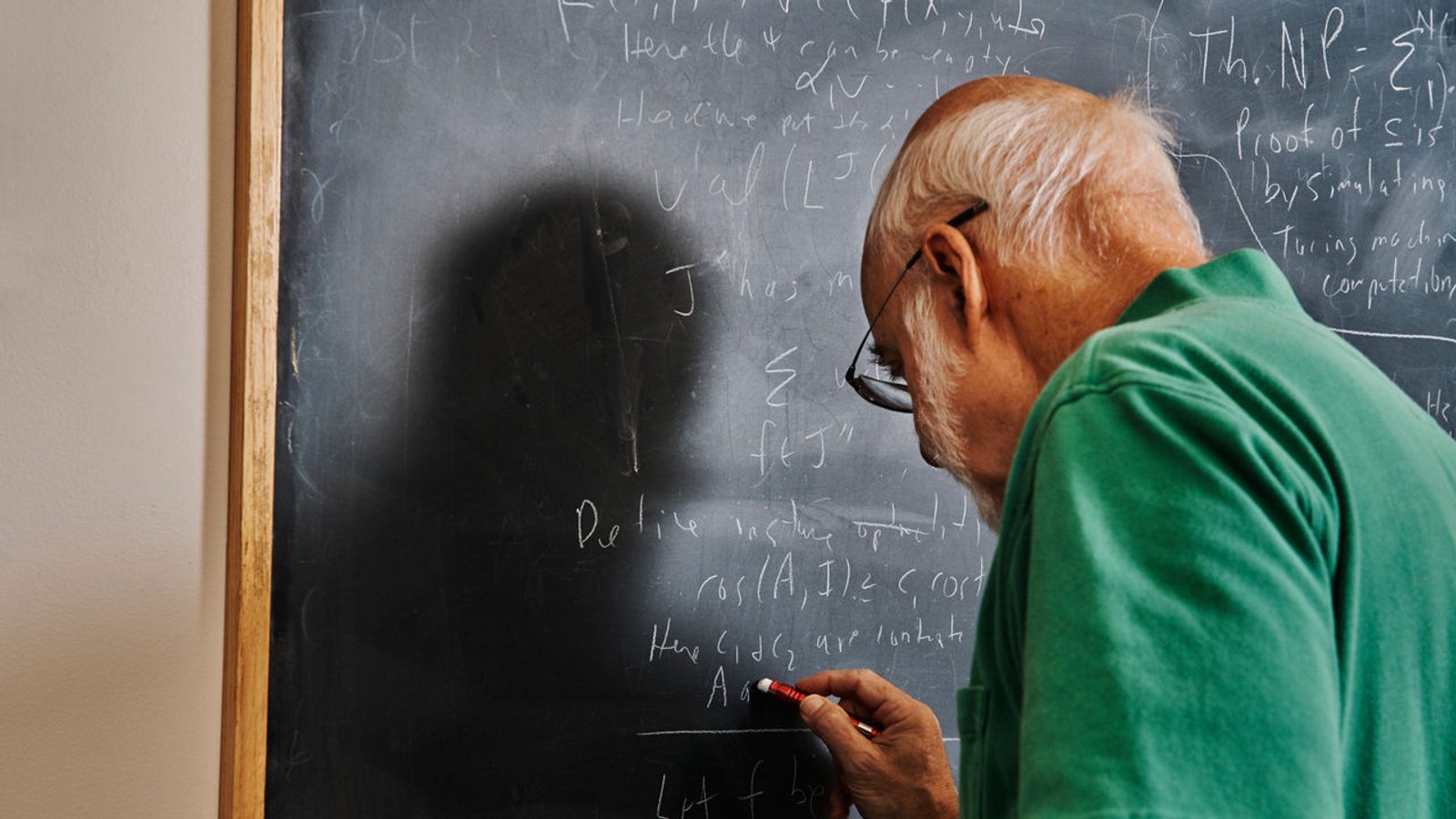
Anthropic mathematician Levent Alpöge claims to have solved the Riemann Hypothesis using the company's AI tool Claude. The breakthrough, if verified, marks a significant milestone in mathematics.
TL;DR
- Anthropic mathematician Levent Alpöge claims to have solved the Riemann Hypothesis using AI tool Claude.
- The solution, if verified, would be a significant breakthrough in mathematics.
- Anthropic's recent IPO raised $81 billion, valuing the company at $1.5 trillion.
What happened
Levent Alpöge, a mathematician at Anthropic, announced on Friday that he believes he has solved the Riemann Hypothesis with the help of Claude, Anthropic's AI tool. Alpöge posted a four-page explanation on his website, detailing the discovery made late Sunday night. The Riemann Hypothesis, formulated in 1859, focuses on the distribution of prime numbers as they approach infinity.
Alpöge released his and Claude's proof within 17 million lines of Lean code, a programming language used for programming proofs of mathematical theorems. The proof is now available for review, though the verification process is expected to be lengthy. The Clay Mathematics Institute, which listed the hypothesis as one of seven Millennium Prize Problems in 2000, offered a $1 million reward for its solution.
Why it matters
If verified, this breakthrough would be a significant milestone in mathematics, potentially transforming the understanding of prime numbers and their distribution. It also highlights the growing role of AI in advancing scientific research. For developers and startups, this news underscores the potential of AI tools like Claude in solving complex problems.
For investors, Anthropic's recent IPO and this potential breakthrough demonstrate the company's capabilities and the value of AI in driving innovation. However, the competitive landscape remains intense, with other AI companies like OpenAI also making strides in similar areas. The verification process will be crucial in determining the actual impact of this claim.
Key facts
- Levent Alpöge is a mathematician at Anthropic who claims to have solved the Riemann Hypothesis using Claude, Anthropic's AI tool.
- The Riemann Hypothesis was formulated in 1859 and focuses on the distribution of prime numbers.
- Alpöge's proof is contained within 17 million lines of Lean code.
- The Clay Mathematics Institute offered a $1 million reward for the solution to the Riemann Hypothesis.
- Anthropic's recent IPO raised $81 billion, valuing the company at $1.5 trillion.
- OpenAI previously claimed a breakthrough in solving the Navier-Stokes equation using its technology.
- The verification process for Alpöge's claim is expected to be lengthy and complex.
Context
The Riemann Hypothesis is one of the most famous unsolved problems in mathematics. Its solution would have profound implications for number theory and cryptography. The involvement of AI in solving such complex problems highlights the growing capabilities of machine learning and its potential to revolutionize various fields of research.
Anthropic's recent IPO and this potential breakthrough demonstrate the company's ambition and the broader industry's focus on advancing AI technology. The competitive dynamics between Anthropic, OpenAI, and other AI companies will be crucial in shaping the future of AI-driven research and development.