CERN and Mistral AI have signed a strategic partnership to develop a foundation model for scientific discovery, starting with a Large Physics Model for high-energy physics. The model will be trained on billions of simulated proton-proton collisions at the Large Hadron Collider (LHC).
TL;DR
- CERN and Mistral AI partner to build a foundation model for collider physics, trained on billions of simulated LHC collisions.
- The Large Physics Model aims to reconstruct particle collisions, identify particles, flag unexpected signals, and evaluate future detector designs.
- The partnership could extend AI approaches to the wider scientific community, with the potential for new scientific discoveries.
What happened
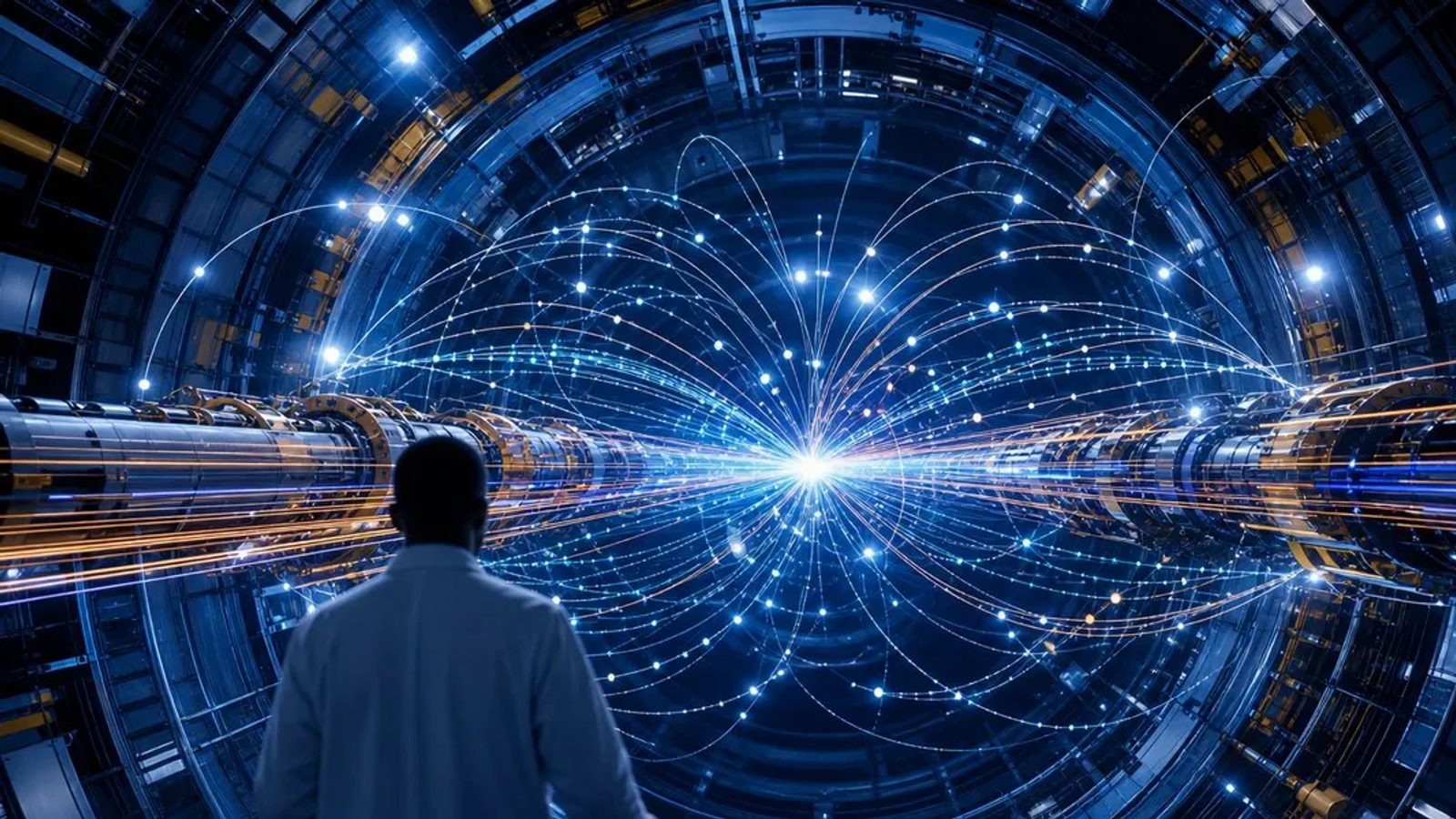
CERN and Mistral AI have signed a statement of intent for a long-term strategic partnership on foundation models for scientific discovery. The initial focus is high-energy physics, with the goal of creating a Large Physics Model for collider physics. CERN will contribute its expertise in fundamental physics, scientific data, and large-scale computing, while Mistral AI will bring large-scale model training capabilities. The model will be trained on billions of simulated proton-proton collisions at the LHC, with the potential to support several tasks, including reconstructing particle collisions, identifying particles, flagging unexpected signals, and evaluating future detector designs. The partnership aims to create AI capabilities that the wider physics community can share, with the potential for new scientific discoveries.
Why it matters
This partnership marks a significant step forward in the application of AI to scientific research, particularly in the field of high-energy physics. The Large Physics Model could revolutionize the way particle collisions are analyzed, making the process more efficient and accurate. The partnership also has the potential to extend AI approaches to other areas of scientific research, with the potential for new discoveries. For developers and startups, this collaboration highlights the growing importance of AI in scientific research and the potential for new applications in this field. For investors, it underscores the value of AI technologies in driving scientific advancements and the potential for significant returns in this area.
Key facts
- CERN and Mistral AI have signed a statement of intent for a long-term strategic partnership on foundation models for scientific discovery.
- The initial focus is high-energy physics, with the goal of creating a Large Physics Model for collider physics.
- The model will be trained on billions of simulated proton-proton collisions at the LHC.
- CERN has stored about one exabyte (one million terabytes) of LHC experimental data to date.
- The High-Luminosity LHC (HL-LHC), expected to start operating around 2030, will increase the number of collisions tenfold.
- The partnership aims to create AI capabilities that the wider physics community can share.
- Enrica Porcari, CERN Chief Information Officer, says high-energy physics offers a unique environment for AI development and testing.
- Johannes Brandstetter, Vice-President of AI for Engineering at Mistral AI, says the company is proud to work with CERN to explore what large-scale AI models can offer to particle physics.
Context
This partnership between CERN and Mistral AI is part of a broader trend of AI being applied to scientific research. AI has the potential to revolutionize the way scientific data is analyzed, making the process more efficient and accurate. This partnership also highlights the growing importance of collaboration between AI developers and scientific institutions in driving advancements in both fields. As AI continues to evolve, we can expect to see more partnerships like this one, with the potential for significant scientific discoveries and advancements.