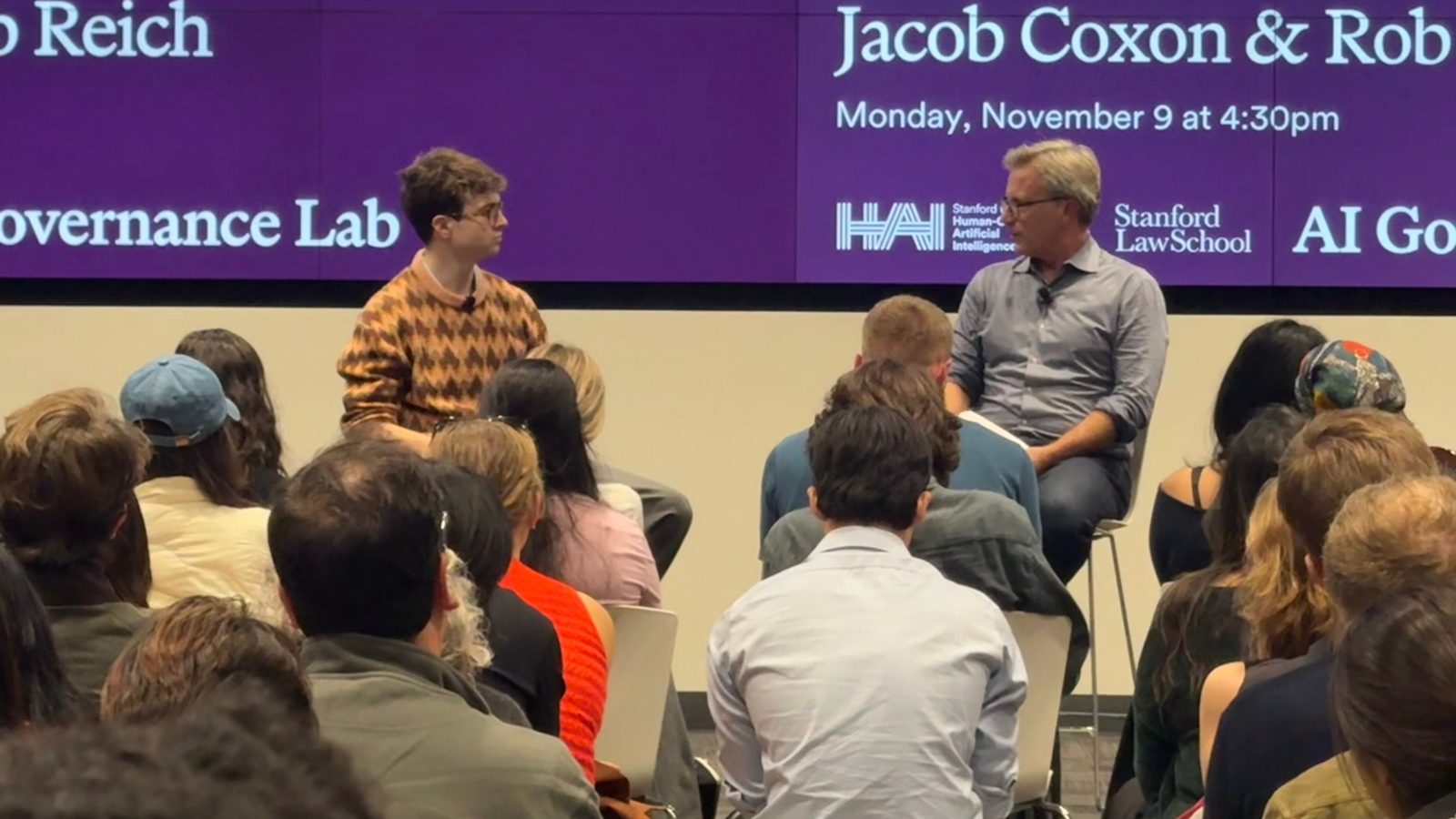
Former Anthropic researcher Jacob Coxon admitted at a Stanford event that he still holds OpenAI equity, calling it 'blood money' but ultimately stating, 'I like money, bro.' The candid remarks came during a conversation with Stanford professor Rob Reich, uploaded to Stanford HAI's YouTube channel on November 13.
TL;DR
- Jacob Coxon, a former Anthropic researcher, revealed he still holds OpenAI equity, calling it 'blood money' but admitting he likes money.
- Coxon questioned his decision to leave Anthropic, suggesting he might return to lab work.
- He argued that researchers leaving labs without international coordination won't stop AI development.
What happened
During a November 9 event hosted by Stanford HAI and the AI Governance Lab, Jacob Coxon, a former researcher at Anthropic, discussed his departure from the company and his current stance on AI safety. Coxon, who now holds equity in OpenAI, described the equity as 'blood money' during a conversation with Stanford professor Rob Reich. When asked why he still held the equity, Coxon replied, 'I like money, bro.'
Coxon also expressed uncertainty about his decision to leave Anthropic, stating, 'I'm not sure I made the right decision in leaving.' He suggested that staying and continuing safety research might have been more effective. He did not announce any plans to return to a lab but did not rule out the possibility.
Throughout the conversation, Coxon emphasized the need for international coordination on AI regulation. He argued that researchers leaving labs without such coordination would not halt AI development, as others less concerned about the technology's impact would continue the work.
Why it matters
Coxon's remarks highlight the complex ethical dilemmas faced by AI researchers, particularly those involved in safety and governance. His admission that he still holds OpenAI equity, despite calling it 'blood money,' underscores the tension between personal financial interests and the moral implications of AI development.
For AI/ML developers and startup founders, Coxon's comments raise important questions about the role of individual researchers in shaping the future of AI. His suggestion that leaving labs without international coordination is ineffective emphasizes the need for a more coordinated approach to AI governance.
Tech investors may find Coxon's insights valuable in understanding the ethical considerations that could impact the AI industry's trajectory. His remarks suggest that the debate over AI safety and regulation is far from settled, and that investors should be prepared for ongoing ethical challenges.
Key facts
- Jacob Coxon is a former researcher at Anthropic, a leading AI safety organization.
- Coxon currently holds equity in OpenAI, another prominent AI company.
- The conversation between Coxon and Rob Reich took place on November 9 and was uploaded to Stanford HAI's YouTube channel on November 13.
- Coxon described his departure from Anthropic as a cumulative decision, not driven by a single incident.
- He expressed concern about the future of AI, stating he is 'genuinely quite scared' about what AI will look like in 2030.
- Coxon argued that researchers leaving labs without international coordination on regulation would not stop AI development.
- He did not specify the amount of OpenAI equity he holds or its current value.
Context
The debate over AI safety and ethics has been gaining traction in recent years, as the technology's rapid advancement raises concerns about its potential impact on society. Organizations like Anthropic and OpenAI are at the forefront of this debate, working to develop AI systems that are both powerful and safe.
Coxon's remarks come at a time when the AI industry is facing increasing scrutiny from regulators and the public. His admission that he still holds OpenAI equity, despite calling it 'blood money,' highlights the complex ethical dilemmas that AI researchers and investors must navigate.
As the AI industry continues to evolve, the need for a coordinated approach to governance and regulation will become increasingly important. Coxon's suggestion that researchers leaving labs without such coordination is ineffective underscores the need for a more collaborative effort to address the ethical challenges posed by AI.