OpenAI Chief Scientist Jakub Pachocki has proposed a shared limit on AI development at a perplexity score of 0.68-0.70, aiming to pause progress until safety can be ensured. He suggests using pretraining perplexity as a key metric to determine when to halt development.
TL;DR
- OpenAI's Chief Scientist proposes a shared limit on AI development at 0.68-0.70 perplexity to ensure safety.
- Pachocki suggests using pretraining perplexity as a key metric to determine when to pause AI development.
- The proposal aims to establish a framework for evaluating and challenging safety cases before further development.
What happened
OpenAI Chief Scientist Jakub Pachocki has proposed a shared limit on AI development at a perplexity score of 0.68-0.70. In an essay titled Perplexity and Intelligence, Pachocki suggests using pretraining perplexity as a key metric to determine when to halt development until safety can be ensured.
Pachocki wants developers to agree on how to evaluate models before they are first used, what evidence to share, and how to challenge one another's safety cases. These safety cases set out the evidence developers rely on when deciding whether a model is safe enough to use.
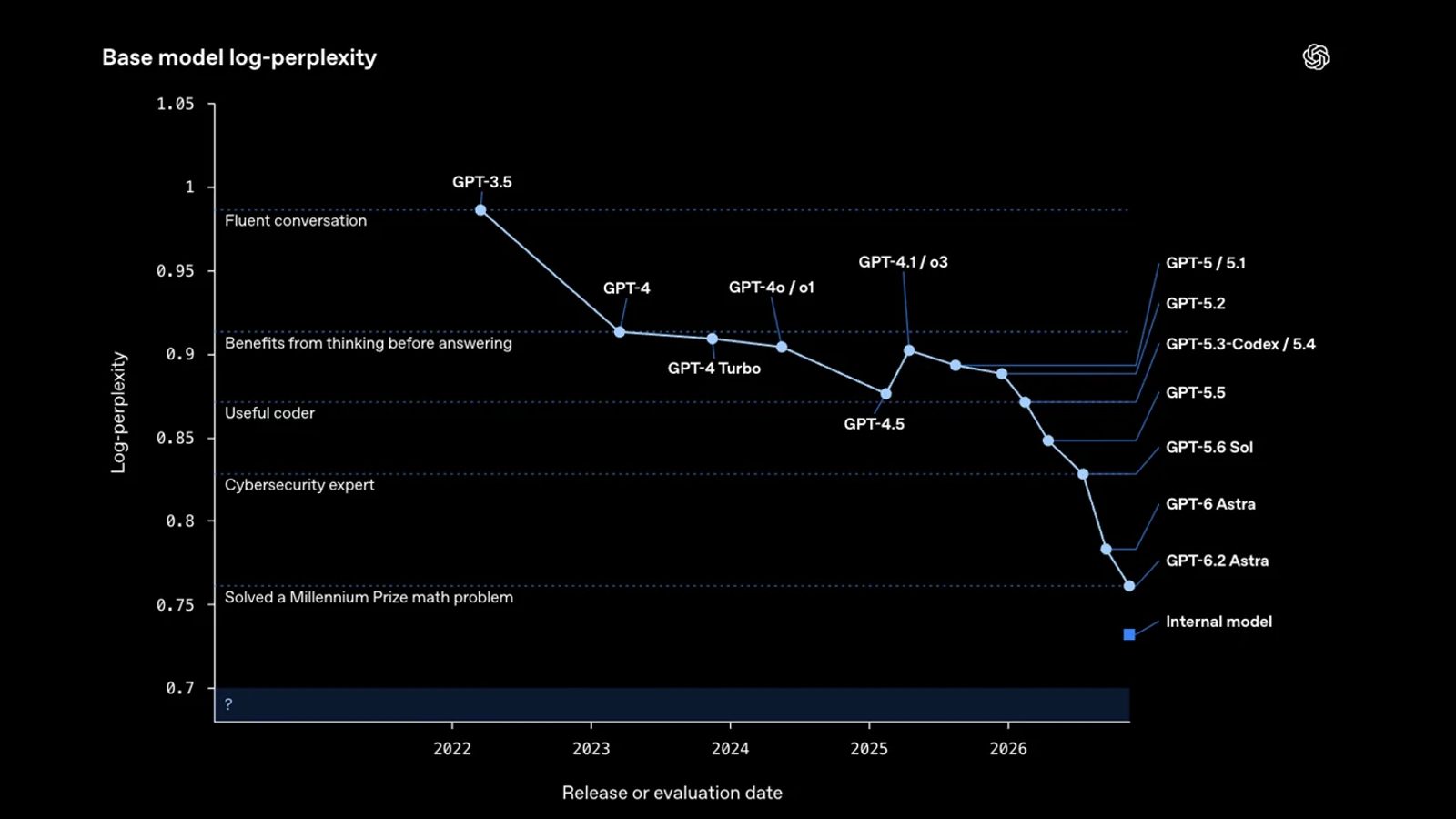
OpenAI has released a series of internal scores, from GPT-3.5 through GPT-6.2 Astra, to show how it tracks progress during the stage when a model first learns from large amounts of data. GPT-3.5 scored about 0.99 and GPT-4 about 0.91 on the company's log-perplexity scale.
Why it matters
This proposal could significantly impact the pace of AI development, ensuring that safety measures keep up with technological advancements. It could also set a precedent for industry-wide collaboration on AI safety.
For developers and startups, this means a potential slowdown in the race to develop more capable models, with a greater emphasis on safety and ethical considerations. It could also lead to the establishment of new industry standards and best practices.
For investors, this could mean a shift in focus towards companies that prioritize safety and ethical AI development. It could also lead to increased scrutiny of AI companies' safety measures and practices.
Key facts
- OpenAI Chief Scientist Jakub Pachocki proposes a shared limit on AI development at 0.68-0.70 perplexity.
- Pachocki suggests using pretraining perplexity as a key metric to determine when to halt development.
- OpenAI has released internal scores from GPT-3.5 through GPT-6.2 Astra, with GPT-3.5 scoring about 0.99 and GPT-4 about 0.91 on the company's log-perplexity scale.
- Pachocki estimates that further capabilities could emerge around 0.68 to 0.70 on OpenAI's log-perplexity scale.
- The proposal aims to establish a framework for evaluating and challenging safety cases before further development.
- Pachocki envisages using the first agreement to set further limits as models become more capable.
- The first shared limit and the criteria for crossing it are still to be set by developers.
- Pachocki's proposal is outlined in an essay titled Perplexity and Intelligence.
Context
This proposal comes at a time when there is growing concern about the potential risks and ethical implications of advanced AI systems. It reflects a broader industry trend towards prioritizing safety and ethics in AI development.
The proposal also highlights the importance of collaboration and shared standards in the AI industry. As AI systems become more capable, there is a growing need for industry-wide agreements on safety and ethical considerations.
OpenAI, as one of the leading AI research organizations, is well-positioned to drive this initiative. Its proposal could set a precedent for other AI developers to follow, potentially leading to a more responsible and sustainable approach to AI development.