OpenAI's research agents have significantly improved their task completion rates, reaching 35% for 4-8 hour tasks, up from 13% in March. The findings come from the company's second report on AI-accelerated research, published on Wednesday.
TL;DR
- OpenAI's research agents now complete 35% of 4-8 hour tasks without human help, up from 13% in March.
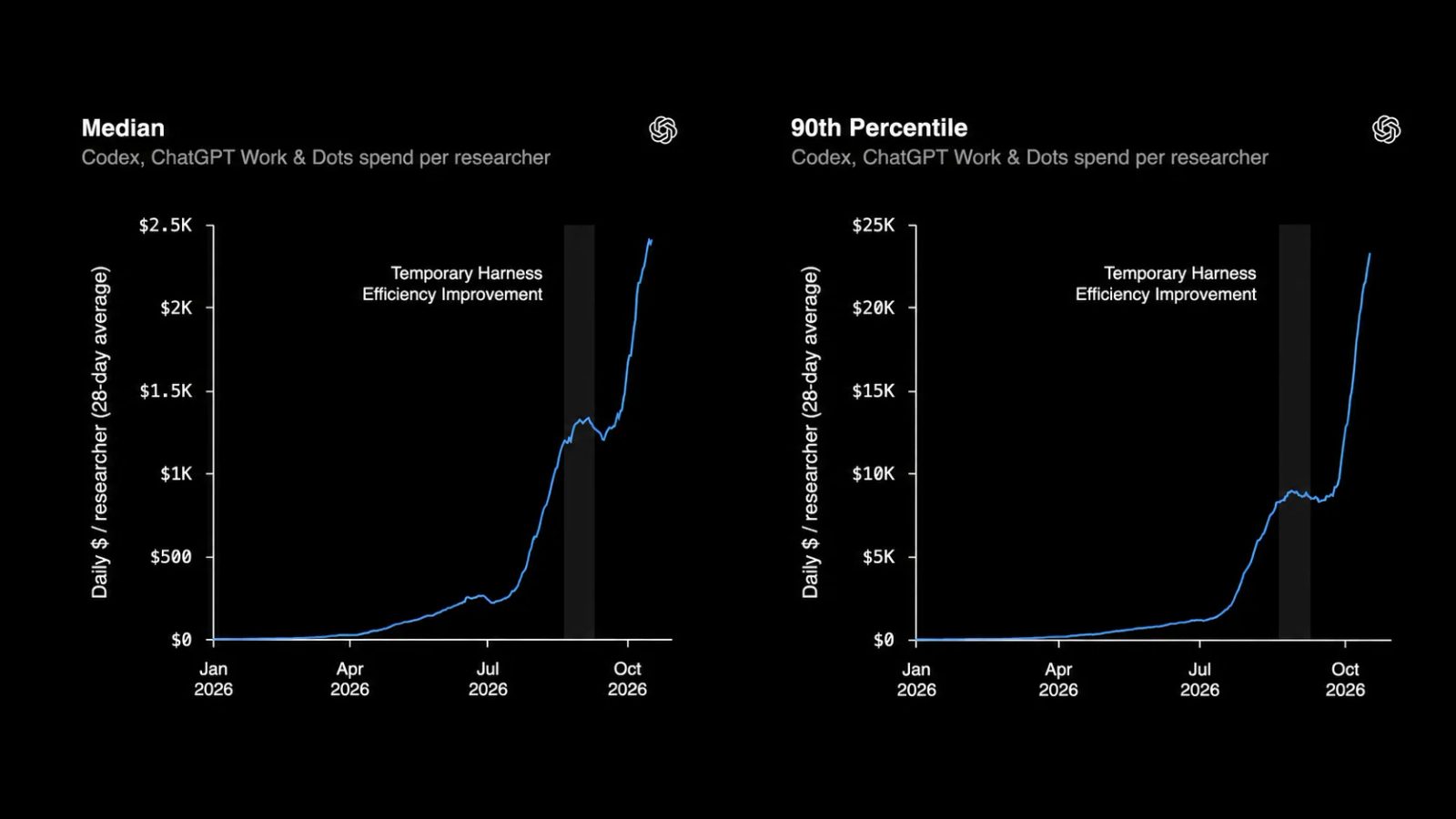
- Median daily agent use per researcher increased 62% from September to October, reaching $2,400.
- OpenAI advocates for tracking and publicly reporting signs of recursive self-improvement in AI.
What happened
OpenAI's research agents have shown substantial improvements in task completion rates, according to the company's second report on AI-accelerated research. For tasks that take 4-8 hours, the success rate rose from 13% in March to 35%. Similarly, for tasks that take 2-4 hours, the success rate increased from 23% to 46%.
The report also revealed that the median daily agent use per researcher increased by 62% from September to October, reaching $2,400. At the 90th percentile, daily use reached about $23,000, more than double September's $11,000. Agent use per researcher rose elevenfold, from 0.5 to 5.7 "agent workdays" a day.
By mid-October, more than two-thirds of researchers ran at least four agents at once at their daily peak. More than 10% ran at least 16. In September, the value of agent use in OpenAI's research organization was about twice its pay bill for researchers, excluding equity.
Why it matters
These improvements highlight the growing capability of AI agents to accelerate research tasks, potentially reducing the need for human intervention. This could have significant implications for AI startups and developers, as it demonstrates the potential for AI to streamline research and development processes.
The substantial increase in agent use and success rates also raises questions about the future of AI research and the role of human researchers. As AI agents become more capable, the competitive landscape for AI startups and companies may shift, with those leveraging AI-accelerated research gaining a significant advantage.
However, OpenAI notes that the gains are jagged and vary widely by task. Agents excel in monitoring and answering technical questions but struggle with tasks like writing code for inference and serving systems. This indicates that while AI agents are becoming more capable, they still require human oversight and intervention in certain areas.
Key facts
- OpenAI's research agents now complete 35% of 4-8 hour tasks without human help, up from 13% in March.
- Median daily agent use per researcher increased 62% from September to October, reaching $2,400.
- At the 90th percentile, daily agent use reached about $23,000, more than double September's $11,000.
- Agent use per researcher rose elevenfold, from 0.5 to 5.7 "agent workdays" a day.
- By mid-October, more than two-thirds of researchers ran at least four agents at once at their daily peak.
- In September, the value of agent use in OpenAI's research organization was about twice its pay bill for researchers, excluding equity.
- OpenAI advocates for tracking and publicly reporting signs of recursive self-improvement in AI.
- OpenAI's internal capabilities index has risen 16.4 points a year since August 2025, compared to Epoch AI's 14 points a year since late 2024.
Context
OpenAI is not alone in publishing data on AI-accelerated research. Anthropic, another leading AI company, has also released reports on its own AI-accelerated research. This trend highlights the growing importance of AI in research and development, as well as the need for transparency and public reporting in this area.
The improvements in OpenAI's research agents also come at a time when the AI industry is facing increasing scrutiny and calls for regulation. As AI agents become more capable, the potential for misuse or unintended consequences also increases. This underscores the need for responsible AI development and deployment, as well as ongoing research into the ethical and societal implications of AI.