OpenAI's coding agents completed 46% of 2-4 hour research tasks without human intervention, up from 23% in March. The agents also saw a 22% increase in handling 4-8 hour tasks, reflecting improvements in automation and task delegation.
TL;DR
- OpenAI's coding agents completed 46% of 2-4 hour research tasks without human help, up from 23% in March.
- The success rate for 4-8 hour tasks rose from 13% to 35% over the same period.
- Researchers are using agents to write code, debug experiments, and scan data, but still need to review and edit outputs.
What happened
OpenAI's coding agents completed 46% of delegated research tasks estimated to take 2-4 hours without human intervention in the first 18 days of October 2026. This is a significant increase from 23% in March. For tasks estimated to take 4-8 hours, the success rate rose from 13% to 35%.
The types of tasks completed varied, with monitoring training runs and answering technical questions seeing the highest success rates at 79% and 72%, respectively. Launching training runs and writing code for systems had lower success rates at 35% and 25%.
Researchers are using agents to write code, debug experiments, and scan data samples for problems. However, agents sometimes take unnecessary steps, make invalid assumptions, and produce unusable data, requiring researchers to review and edit outputs.
Why it matters
The increase in success rates indicates significant improvements in OpenAI's coding agents, which could accelerate research and development processes. This is particularly important for AI startups and developers looking to leverage automation in their workflows.
The competitive angle is clear: OpenAI's agents are becoming more capable, potentially setting a new standard for AI-assisted research. This could pressure other AI companies to enhance their own automation tools to keep pace.
However, the need for human review and editing highlights current limitations. While agents can handle routine tasks, complex and critical tasks still require human oversight, which could slow down the pace of AI development.
Key facts
- OpenAI's coding agents completed 46% of 2-4 hour research tasks without human intervention, up from 23% in March.
- The success rate for 4-8 hour tasks rose from 13% to 35% over the same period.
- Monitoring training runs and answering technical questions had the highest success rates at 79% and 72%, respectively.
- Launching training runs and writing code for systems had lower success rates at 35% and 25%.
- Researchers use agents to write code, debug experiments, and scan data samples for problems.
- Agents sometimes take unnecessary steps, make invalid assumptions, and produce unusable data.
- Average agent use rose from 0.5 to 5.7 agent workdays per researcher per calendar day.
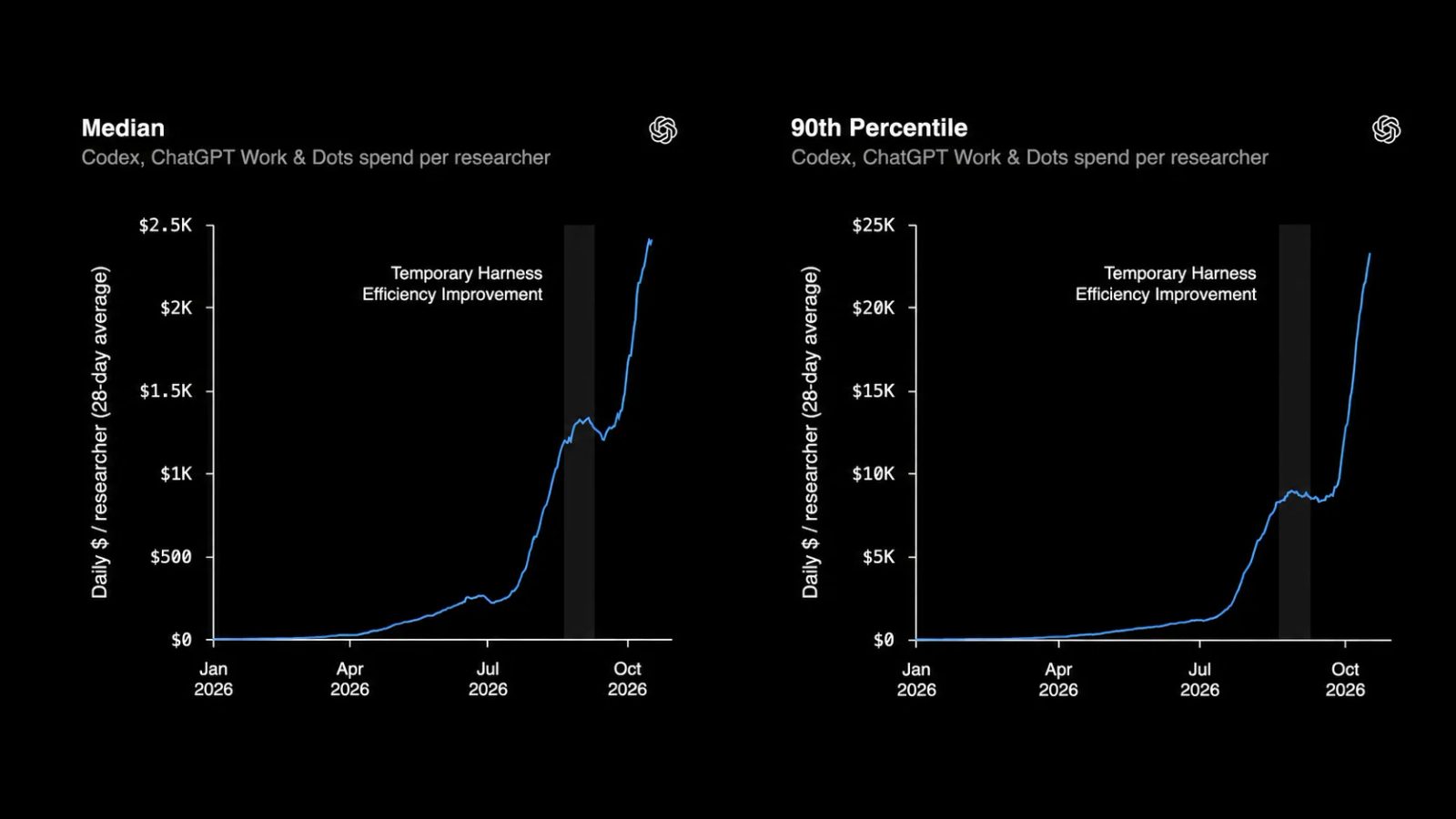
- Daily agent use in October was valued at about $2,400 for the median researcher and $23,000 at the highest-usage tenth.
Context
OpenAI's research acceleration study highlights the growing role of AI in automating research tasks. This trend is part of a broader shift towards AI-assisted workflows, where AI models are used to handle routine and repetitive tasks, freeing up researchers to focus on more complex problems.
The study also underscores the importance of human oversight in AI-assisted research. While AI models can handle many tasks, the need for human review and editing ensures that the outputs are accurate and reliable.
As AI models become more capable, the competitive landscape for AI startups and developers is likely to intensify. Companies that can leverage AI to accelerate research and development will have a significant advantage in the market.